
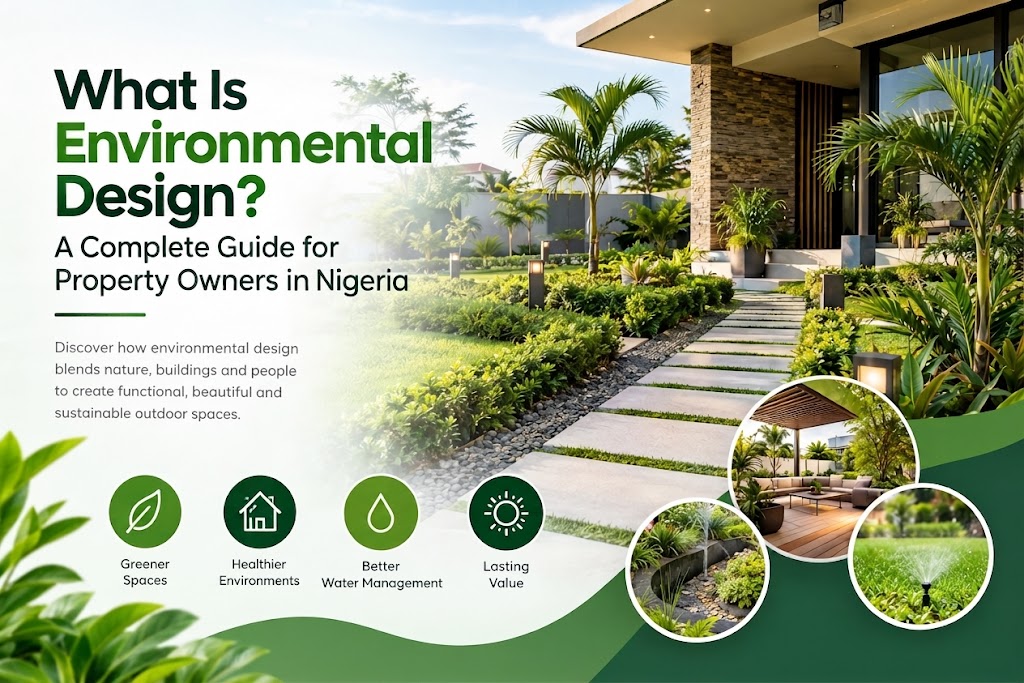
What is environmental design? It is a planning approach that considers how buildings, outdoor spaces, people, vegetation, water, materials, and natural conditions can work together as part of a functional environment. For property owners in Nigeria, understanding this approach can help create outdoor areas that are attractive while also responding to practical issues such as drainage, usability, planting, irrigation, maintenance, and the relationship between a building and its surroundings. Casaterranova provides Environmental Design alongside related landscape and outdoor design services for properties across Nigeria.
Casaterranova
Website: www.casaterranova.ng
Phone: +234 911 351 5312
Address: 9 Jerry Gana Close, Utako, Abuja
What Is Environmental Design?
Environmental design is the process of planning spaces by considering both human requirements and the natural and built conditions surrounding them. Rather than treating a garden, building, drainage system, planting area, pathway, or outdoor feature as an isolated element, the approach considers how those elements interact.
The concept therefore goes beyond making a property look attractive. A successful environmental design should respond to the purpose of the site, available space, existing conditions, environmental considerations, movement patterns, water management, planting requirements, and future maintenance.
The American Society of Landscape Architects emphasizes the importance of considering natural ecosystems and human activity during planning, design, construction, and maintenance.
For property owners, this means the outdoor environment can be planned as an important part of the property rather than as something added after the building is completed.
How Environmental Design Connects People, Buildings, and Nature
A property contains several connected systems. There may be buildings, lawns, planting areas, entrances, walkways, open spaces, drainage routes, lighting, irrigation, and other outdoor elements.
Environmental design considers how these components relate to one another.
For example, an entrance should work with the surrounding landscape rather than appearing disconnected from it. Similarly, planting should be selected and positioned according to the available space, environmental conditions, intended appearance, and maintenance requirements.
This relationship becomes particularly important on larger residential estates, office properties, hotels, and commercial developments where outdoor areas have several different functions.
The United Nations Environment Programme also recognizes that urban environments function as ecosystems and that nature-based approaches can help address challenges such as flooding, erosion, heat, air quality, and water management.
Environmental Design vs Traditional Landscaping
Traditional landscaping can focus primarily on planting, lawns, gardens, decorative features, and the appearance of outdoor areas. Environmental design takes a broader planning perspective.
It can consider the building, site conditions, outdoor circulation, vegetation, water movement, usability, materials, lighting, irrigation, and maintenance as connected parts of one environment.
This does not mean ordinary landscaping is separate from environmental design. Instead, services such as Residential Landscaping, Corporate Landscaping Services, Landscape Construction, Outdoor Lighting, Irrigation System Installation, and Lawn Care & Maintenance can become components of a broader environmental design approach when they are appropriate to the project.
Casaterranova’s Environmental Design service is therefore relevant to property owners who want outdoor planning to address more than appearance alone.
Why Site Conditions Matter in Outdoor Planning
Every property has different conditions. The size and shape of the site, existing vegetation, drainage, sunlight, circulation, building arrangement, and intended use can all influence the appropriate design.
A solution that works on a large estate may not be suitable for a compact urban property. Likewise, an office building may require a different outdoor strategy from a private residence or hotel.
The U.S. Environmental Protection Agency notes that green infrastructure should be tailored to site-specific conditions and that factors such as soil conditions can affect which approaches are suitable.
Consequently, understanding the site before selecting features is an important part of responsible environmental planning.
Core Principles of Environmental Site Planning
Environmental design is not based on one fixed formula. However, several principles help property owners understand how a well-planned outdoor environment can be developed.
Function and Usability
An outdoor area should serve a purpose.
A residential property may need usable garden space, lawns, circulation areas, or areas for relaxation. An office may require organized entrances, pathways, landscaped surroundings, and practical external spaces. A hotel may need attractive guest-facing areas that complement the building.
Therefore, the first question should not simply be, “What should this space look like?” It should also be, “How will people use this space?”
Environmental Sustainability
Environmental sustainability means considering how a project interacts with natural systems and resources.
Plant selection, water requirements, material choices, shade, surface conditions, and maintenance can all influence the long-term performance of an outdoor environment.
The goal is not necessarily to eliminate every conventional material or feature. Instead, environmental design considers how the selected elements can work together in a practical and responsible way.
UNEP identifies nature-based solutions as an approach that can help urban areas address environmental challenges while also providing benefits for people and ecosystems.
Water Management and Drainage
Water management is an important consideration for outdoor environments.
Poorly planned water movement can affect lawns, planting areas, soil, pathways, and other parts of a property. Consequently, drainage should be considered during planning rather than treated as an afterthought.
Environmental design can account for how water moves across the site and how landscape elements interact with existing drainage conditions.
The EPA describes green infrastructure as a multi-benefit approach to stormwater management and emphasizes the importance of planning, design, implementation, operation, and maintenance.
For Nigerian property owners, this makes site-specific assessment particularly relevant when planning outdoor environments.
Planting and Natural Systems
Plants are not simply decorative elements.
Their placement, water requirements, growth characteristics, relationship to buildings, and maintenance requirements should all be considered when developing an outdoor environment.
A well-planned planting strategy can help connect buildings with surrounding outdoor areas while creating spaces that are visually coherent and practical to maintain.
The appropriate planting approach will depend on the property and its conditions. Therefore, property owners should avoid selecting plants solely because they look attractive in isolation.
Long-Term Maintenance
Environmental design should consider what happens after installation.
Lawns, planting areas, irrigation systems, outdoor lighting, and other landscape elements require appropriate care. If a design is difficult to maintain, the property owner may face unnecessary replacement or maintenance requirements later.
For this reason, maintenance should form part of the planning conversation from the beginning.
Casaterranova provides Lawn Care & Maintenance as one of its approved services, alongside Environmental Design and other related outdoor services.
How Environmental Design Works for Different Nigerian Properties
Environmental design can be adapted to different property types because each site has its own purpose and requirements.
Residential Properties
For homeowners, environmental design can help connect the house with its surrounding outdoor areas.
The planning may consider lawns, planting, circulation, outdoor spaces, lighting, irrigation, and maintenance requirements. The objective is to create an environment that complements the home while remaining practical for everyday use.
Residential Landscaping can therefore become one component of a broader environmental design strategy.
Office and Corporate Properties
Office environments have different requirements because outdoor areas may be used by employees, visitors, clients, tenants, and service providers.
The entrance, surrounding landscape, pathways, planting areas, lighting, and other external features should work together to create a coherent environment.
Corporate Landscaping Services and Landscaping for Office Buildings can support this type of project where they match the property’s requirements.
Hotels and Hospitality Properties
Hotels often have several outdoor areas that contribute to the overall guest experience.
Environmental design can help coordinate the relationship between buildings, gardens, entrances, outdoor circulation, planting, lighting, and other appropriate landscape elements.
However, the design should remain practical to maintain. A visually impressive feature that is difficult to operate or maintain may not be appropriate for the property.
Commercial and Development Projects
Commercial properties and development projects often need outdoor environments that balance appearance with function.
For example, entrances need to be easy to understand and navigate, while planted areas can help organize larger outdoor spaces. Lighting, irrigation, landscape construction, and maintenance can also become part of the wider plan where required.
For commercial projects, commercial outdoor design can therefore work alongside environmental planning to create a more coordinated exterior.
What Property Owners Should Consider Before Starting
Before beginning an environmental design project, property owners should understand what they want the outdoor environment to achieve.
Site Assessment and Existing Conditions
The existing property should be examined before design decisions are finalized.
Relevant considerations can include available space, building arrangement, drainage, sunlight, existing vegetation, soil conditions, movement patterns, and current outdoor problems.
This helps prevent decisions that may look good on paper but fail to suit the actual site.
Intended Use of the Outdoor Space
Property owners should define how the space will be used.
A family home, hotel, office, commercial property, and development project may all require different outdoor environments.
Defining the intended use early helps guide decisions about layout, planting, circulation, lighting, irrigation, and maintenance.
Materials, Planting, Lighting, and Irrigation
Individual landscape elements should work together.
Materials should suit the intended environment, planting should be appropriate to the site’s conditions, lighting should serve a clear purpose, and irrigation should be considered where plants or lawns require controlled watering.
Casaterranova’s approved services include Environmental Design, Landscape Construction, Outdoor Lighting, Irrigation System Installation, and Lawn Care & Maintenance, allowing these elements to be considered together where appropriate.
For additional context, property owners can also read How Environmental Design Improves Property Value when considering how coordinated outdoor planning can affect the overall presentation and functionality of a property.
Future Maintenance Requirements
A design should remain practical after the initial installation.
Property owners should consider how lawns will be maintained, how plants will be cared for, whether irrigation will be needed, and how outdoor lighting and other landscape components will be managed.
In addition, maintenance requirements should be realistic for the property owner and the intended use of the space.
Another useful related resource is Environmental Design vs Landscape Design: What’s the Difference? for property owners who want to understand how these approaches relate to one another.
How Casaterranova Applies Environmental Design in Nigeria
Casaterranova approaches environmental design as part of a wider landscape and outdoor planning process.
Its approved services include Environmental Design, Landscape Construction, Residential Landscaping, Corporate Landscaping Services, Rooftop Design, Landscaping for Hotels, Landscaping for Office Buildings, Commercial Outdoor Design, Outdoor Lighting, Irrigation System Installation, and Lawn Care & Maintenance. These services can be considered according to the specific requirements of a property rather than automatically applying every service to every project.
For example, a residential property may require Environmental Design and Residential Landscaping, while a commercial property may need Environmental Design alongside Commercial Outdoor Design, Landscape Construction, Outdoor Lighting, Irrigation System Installation, or Lawn Care & Maintenance.
The company’s published approach also identifies site analysis as an important stage, including consideration of soil condition, drainage, sunlight exposure, and space utilization.
Property owners can therefore use environmental design as a framework for thinking about the entire outdoor environment rather than focusing on individual landscaping features separately.
If you are planning an outdoor environment for a home, estate, hotel, office, or commercial property in Nigeria, Casaterranova specializes in Environmental Design and related landscape services. Visit www.casaterranova.ng to discuss your property’s requirements and explore an appropriate design approach.
Conclusion
Environmental design is a broader approach to planning outdoor environments around the relationship between people, buildings, nature, water, vegetation, materials, and site conditions. For Nigerian property owners, it can provide a practical framework for creating outdoor spaces that are attractive, functional, environmentally considered, and manageable over time.
Rather than selecting landscaping features individually, property owners can consider how each element contributes to the overall purpose and performance of the site. Site assessment, drainage, planting, usability, irrigation, lighting, construction, and maintenance can all play a role depending on the project.
Casaterranova provides Environmental Design and related approved landscape services for property owners and developments in Nigeria.
Casaterranova
Website: www.casaterranova.ng
Phone: +234 911 351 5312
Address: 9 Jerry Gana Close, Utako, Abuja
FAQs About What Is Environmental Design?
1. What is environmental design in simple terms?
Environmental design is the planning of buildings and outdoor environments in a way that considers people, natural conditions, vegetation, water, materials, usability, and the relationship between different parts of a site. It aims to create environments that function well while responding appropriately to their surroundings.
2. Is environmental design only about landscaping?
No. Landscaping can be part of environmental design, but environmental design takes a broader view. It can consider the relationship between buildings, outdoor spaces, vegetation, drainage, circulation, materials, lighting, irrigation, usability, and long-term maintenance.
3. Who can benefit from environmental design?
Homeowners, estate developers, hotel managers, office managers, and commercial property owners can all use environmental design principles. The specific approach depends on the property’s purpose, size, existing conditions, outdoor requirements, and expected use.
4. What does an environmental design professional assess first?
The assessment can consider the site’s available space, existing buildings, drainage, soil conditions, sunlight, vegetation, circulation, intended use, and other relevant site conditions. Understanding these factors helps ensure the proposed outdoor environment is appropriate for the property.
5. Can environmental design address drainage problems?
Environmental design can incorporate drainage and water-management considerations into the wider planning of a property. The appropriate solution depends on the site’s existing conditions, water movement, soil, layout, and project requirements.
6. Does environmental design require sustainable materials?
Not necessarily. Environmental design is broader than simply choosing sustainable materials. It considers how materials, vegetation, water, buildings, outdoor spaces, maintenance requirements, and other elements work together within the specific site.
7. Can environmental design be used for an existing property?
Yes. Environmental design can be applied when improving an existing property as well as when planning a new development. Existing conditions can be assessed first so that the proposed outdoor environment responds to the property’s current layout and requirements.
8. How does environmental design affect outdoor maintenance?
Maintenance can be considered during the design stage. Plant selection, irrigation requirements, lawn areas, lighting, materials, and the complexity of the landscape can all influence how much ongoing care the property requires.
9. Is environmental design suitable for small properties?
Yes. Environmental design does not depend solely on having a large property. Even a smaller site can benefit from thoughtful planning that considers available space, circulation, planting, water management, usability, and maintenance.
10. Can Casaterranova provide environmental design services in Nigeria?
Yes. Environmental Design is one of Casaterranova’s approved services. The company also provides related services including Landscape Construction, Residential Landscaping, Corporate Landscaping Services, Rooftop Design, Landscaping for Hotels, Landscaping for Office Buildings, Commercial Outdoor Design, Outdoor Lighting, Irrigation System Installation, and Lawn Care & Maintenance.